• Skip to main content

MetricaOS

Hide Search

Blog

How to Choose an AI Usage Billing Platform

Jeenfer Wilson · October 17, 2026 · Leave a Comment

Choosing an AI usage billing platform is not simply about finding software that can count tokens or generate invoices.

The right platform should connect what customers consume, what that usage costs your business, and what customers should ultimately pay.

For an AI product, that means evaluating several capabilities together:

  • Accurate usage metering and customer attribution
  • Flexible pricing and usage-rating rules
  • Credits, allowances, quotas, and overages
  • Reliable event processing and billing records
  • Cost visibility and customer profitability
  • Developer integration and operational controls

A platform may perform one of these functions well without supporting the others.

The best choice depends on your product’s usage model, pricing strategy, engineering resources, and expected growth.

This guide explains how to evaluate those tradeoffs and what to test before committing to a platform.

What is an AI usage billing platform?

An AI usage billing platform is infrastructure that helps AI companies measure product consumption and translate it into customer-facing pricing, allowances, credits, or charges.

For example, an AI application may consume:

  • 4,200 input tokens
  • 650 output tokens
  • Two model requests
  • One document-processing operation

The customer might see that activity as 50 credits, one completed document, or a monetary usage charge.

A billing platform helps maintain the relationship between the underlying activity and its commercial treatment.

This typically involves a process such as:

Usage events → Metering → Attribution → Pricing → Credits or billable units → Billing

The stages are closely related, but they serve different purposes.

AI usage metering records consumption. Pricing rules interpret that consumption. Billing determines how it affects customer charges.

Understanding this distinction is the starting point for evaluating platforms.

First, identify what kind of platform you actually need

Several categories of software can appear similar during an initial search.

However, they solve different problems.

Platform categoryPrimary responsibility
Usage meteringCapture and aggregate measurable product consumption
AI cost monitoringTrack provider costs, models, and spending
Usage ratingApply commercial pricing rules to measured usage
Billing and invoicingCalculate charges and produce invoices
Payment processingCollect payments from customers
AI monetization infrastructureConnect usage, costs, pricing, credits, limits, and billing

These capabilities can overlap.

For example, a general billing platform may support metered charges but require your application to calculate the usage before submission.

An AI monitoring tool may provide excellent token visibility without managing customer credits or subscription entitlements.

An AI-focused monetization platform may combine several of these responsibilities.

The question is not which category has the most features. It is which responsibilities you want the platform to own.

If you are primarily trying to collect subscription payments, you may not need a specialized AI metering platform.

But if you are building a product with different models, customer allowances, credits, and variable infrastructure costs, the usage layer deserves much closer attention.

1. Start with your pricing model, not the vendor’s feature list

Before comparing products, define how you intend to charge customers.

Consider three different AI businesses.

AI API provider

Customers are developers who understand tokens, requests, and model pricing.

Direct consumption-based pricing may work well.

AI document-processing SaaS

Customers think in terms of documents, pages, and completed tasks rather than tokens.

Credits or documents processed may be more understandable.

AI agent platform

A single agent task might involve several model calls, tools, retries, and external services.

Pricing may be based on executions, credits, outcomes, or a hybrid model.

Each business needs different billing flexibility.

A platform optimized for token-based billing may be sufficient for the first company but restrictive for the others.

Before choosing a vendor, answer:

  • What underlying metrics will we measure?
  • What unit will customers see?
  • Will subscriptions include allowances?
  • Will unused usage roll over?
  • Can customers purchase additional usage?
  • Will expensive features consume more credits?
  • Do enterprise customers need custom pricing?

These decisions should guide your evaluation.

For a detailed comparison of customer-facing pricing units, see AI Credits vs Tokens: Which Pricing Unit Should Your AI Product Use?.

2. Evaluate how the platform captures usage events

Every usage-based billing system depends on reliable usage data.

An AI application may create events for model requests, document analysis, image generation, transcription, agent executions, or custom product actions.

A basic event might contain:

Event ID: evt_123
Customer ID: cus_456
Feature: document_summary
Provider: provider_a
Model: model_x

Input tokens: 4,200
Output tokens: 650

This is an illustrative example, not a platform-specific API format.

A good metering platform should support the data model your product actually needs.

Questions to ask

Does it support custom usage metrics?

Today, you might only measure input and output tokens.

Tomorrow, you might need audio minutes, pages processed, GPU hours, or agent executions.

A rigid schema can become an expensive limitation.

Can you attach customer and product context?

You may need to associate usage with a customer, workspace, user, feature, model, or project.

Does it support real-time and batch ingestion?

Real-time ingestion matters when usage affects balances or limits.

Batch ingestion can be useful for imports, delayed processing, or historical backfills.

Can you retrieve and investigate individual events?

Aggregated dashboards are useful, but debugging a disputed charge may require access to the original event.

A flexible event model becomes especially valuable as the product adds new AI capabilities.

For a deeper explanation, see What Is a Usage Event?.

3. Check whether usage can be attributed to customers and features

Measuring total AI consumption is relatively straightforward.

Understanding who generated that consumption is more valuable commercially.

Suppose your company spends $15,000 on model providers in one month.

That number does not reveal whether:

  • One customer generated 30% of the spend
  • An expensive feature is being used excessively
  • A premium model is affecting margins
  • Internal testing is mixed with production usage

A useful billing platform should preserve enough context to support customer-level and feature-level analysis.

At minimum, evaluate whether you can answer:

How much did Customer A consume this month?

Which AI feature generated the most usage?

Which model contributed the most cost?

How does consumption compare across pricing plans?

This is closely connected to cost per customer.

Without customer attribution, you may successfully invoice customers while still having limited visibility into whether those customers are profitable.

4. Look carefully at pricing and usage-rating flexibility

This is one of the most important evaluation criteria.

Metering measures consumption. Rating determines how that consumption should count commercially.

Imagine a product that offers a basic language model, a premium model, and an AI research workflow.

Charging identical amounts for all three may not make sense.

The underlying costs and customer value can be different.

Your platform should support the pricing distinctions your business requires.

What to evaluate

Metric-based pricing

Can different metrics be charged differently?

For example, input tokens, output tokens, and workflow executions may require separate rules.

Provider- and model-specific pricing

Can the platform account for differences between providers and models?

Conditional pricing

Can pricing depend on the event type, feature, customer, or other meaningful context?

Customer-specific terms

Can enterprise customers have different commercial arrangements?

Pricing changes

Can you introduce new rules without rewriting every AI integration?

Historical consistency

Can the system explain how older usage was priced, even after pricing rules change?

The last point is particularly important.

You do not want a customer dispute to become impossible to investigate because the original pricing logic is no longer available.

A useful trial should therefore test not only whether a rule can be created, but whether its results remain explainable.

5. Evaluate credits, wallets, and subscription allowances

Many AI SaaS companies do not want to expose tokens or infrastructure costs directly to customers.

Instead, they use credits.

For example:

Customer actionCredits
Generate an email10
Summarize a document50
Analyze a report150
Execute an agent workflow500

These are illustrative prices. Actual credit values should reflect product economics.

If your product uses credit-based pricing, the billing platform needs more than a simple balance counter.

Evaluate whether it can manage:

  • Monthly subscription allocations
  • Credit purchases and adjustments
  • Credit consumption history
  • Refunds and corrections
  • Customer-level balances
  • Rollover policies
  • Plan changes
  • Negative balances or overages, where permitted

Why the transaction history matters

Suppose a customer asks:

Why did my balance drop from 20,000 to 14,000 credits?

A balance alone cannot answer that question.

The platform should preserve sufficient transaction history to explain how the balance changed.

A reliable credit system should make consumption traceable, not just calculate the remaining balance.

This becomes increasingly important when credits have monetary value or appear in enterprise contracts.

6. Understand how quotas and overages are enforced

A billing platform may support usage limits, but the word limit can describe different behaviors.

Consider these policies:

PolicyCustomer experience
Hard limitUsage stops when the allowance is exhausted
Soft limitUsage continues, with warnings or upgrade prompts
OverageUsage continues and additional consumption is charged
Prepaid creditsUsage consumes a previously funded balance

You need to know which policies your product requires.

For instance, a self-serve AI image application might need strict spending controls.

An enterprise AI agent performing important business workflows may need uninterrupted execution with overage billing.

Both are reasonable commercial models.

The important technical question

When does the platform check whether usage is allowed?

If a system only records usage after a costly model request completes, the application may exceed its intended allowance before discovering that the limit has been reached.

Depending on your workload, you may need a pre-request entitlement check, usage reservation, or another mechanism for controlling spending.

Ask vendors to demonstrate the exact enforcement behavior rather than assuming that having a quota dashboard means usage is blocked automatically.

Also test what happens when a customer’s allowance runs out in the middle of a multi-step workflow.

For the underlying concepts, see usage quota.

7. Test reliability before trusting the platform with invoices

A visually impressive dashboard does not prove billing reliability.

Real production systems encounter duplicate events, delays, retries, missing configurations, and pricing changes.

These situations matter because they can directly affect customer charges.

Duplicate events

An application may retry submitting a usage event after a timeout.

Does the platform prevent the same event from being counted twice?

Look for clear idempotency and deduplication behavior.

Late-arriving events

Some events may arrive after their original billing period or after an invoice has been generated.

How are they handled?

Unmatched usage

What happens when the system receives usage for a new model or event type without a matching pricing rule?

The platform should not silently invent a charge.

Corrections and adjustments

If usage was priced incorrectly, can the result be corrected without destroying the original record?

Auditability

Can your team trace a charge back to the relevant usage and pricing decision?

These are not obscure enterprise requirements.

They become important as soon as real customers begin questioning balances or invoices.

A strong billing platform should have a deliberate approach to exceptional events, not only a working demonstration of the happy path.

8. Separate billable usage from infrastructure cost

An AI request can create real infrastructure cost without necessarily creating a customer charge.

For example:

  • The customer is using a free trial
  • The request is included in their subscription
  • The operation fails
  • Promotional credits cover the usage
  • Internal testing generates the request
  • The company decides to waive the charge

A platform should help maintain a distinction between what happened, what it cost, and what should be charged.

That is the purpose of separating raw usage from billable usage.

During evaluation, ask how the platform handles a request that consumes provider resources but should not create an additional customer charge.

If the platform assumes every incoming event is automatically billable, your application may need substantial custom logic around it.

9. Check how billing connects to invoicing and payments

Metering and invoicing should work together, but they are not interchangeable.

A metering system may accurately record 100,000 API calls.

That does not automatically determine the invoice total.

The final amount may depend on:

  • Included allowances
  • Credit balances
  • Volume tiers
  • Overage rates
  • Discounts
  • Customer-specific contracts
  • Tax treatment
  • Billing currency
  • Adjustments

You should understand which of these calculations happen inside the platform and which remain your application’s responsibility.

Questions worth asking

Does the platform generate invoices or only calculate usage?

Can invoice charges be traced to the underlying billable consumption?

Does it support the currencies your customers require?

How does it connect to your payment provider?

Can customers have different billing cycles or negotiated terms?

What happens when an invoice must be corrected?

You do not necessarily need one vendor to handle metering, invoicing, and payment collection.

A well-defined integration between these functions can be perfectly reasonable.

The priority is ensuring they produce a consistent financial result.

10. Evaluate cost visibility and customer profitability

This capability is particularly important for AI products.

Traditional SaaS pricing often assumes relatively stable incremental software costs.

AI products can incur meaningful variable costs every time customers use expensive models or workflows.

Consider two customers on the same plan:

MetricCustomer ACustomer B
Monthly revenue$199$199
Model cost$25$240
Other variable cost$10$20
Gross profit$164-$61

Both customers generate the same subscription revenue.

But their economics are very different.

A billing platform with cost visibility can help connect usage to provider spending and customer revenue.

Useful capabilities include:

  • Provider- and model-level cost tracking
  • Customer-level spend analysis
  • Feature-level cost attribution
  • Revenue and cost reporting
  • Gross-profit or margin analysis
  • Trends that help forecast future consumption

Not every billing platform needs to provide full financial analytics.

However, you should know whether it makes the required data available.

If you cannot understand customer economics using the platform itself, you may need to export the data to another system.

For a deeper discussion, see AI Cost Attribution.

11. Examine developer experience and integration effort

An AI usage billing platform becomes part of your product infrastructure.

Its developer experience matters.

A vendor may advertise dozens of features while still requiring weeks of engineering work to integrate.

Look beyond the feature list.

API quality

Are the APIs clearly documented?

Can you authenticate securely, submit events, retrieve usage, and access the operations your application needs?

Flexible integration

Can the platform work with your existing architecture, or does it require a particular AI framework?

Testing

Can engineers test events and pricing rules without affecting real customer balances?

Webhooks

Can important billing events trigger updates in your application?

Examples might include low balances, subscription changes, or the start of overage usage.

Data access

Can usage and billing records be exported for analytics, reconciliation, or migration?

Documentation

Do the docs explain error responses, retry behavior, identifiers, and usage semantics?

The best platform on paper may not be the best platform for your team if integration and ongoing maintenance are disproportionately difficult.

For a small AI startup, engineering time is often one of the most important costs in this decision.

12. Review security and operational requirements

Billing systems handle commercially sensitive information.

Depending on your application, they may process customer identifiers, usage patterns, pricing rules, and financial records.

Evaluate the platform’s documented security and operational controls.

Important questions include:

  • How are API credentials managed?
  • Are customer and tenant records appropriately isolated?
  • What access controls are available?
  • Can important administrative changes be audited?
  • What data export and deletion options exist?
  • What are the retention policies?
  • What uptime and support commitments are offered?
  • What happens during an ingestion outage?

For enterprise customers, you may also need to evaluate contractual terms, data residency, compliance evidence, and access to support.

Do not assume a vendor satisfies a security or compliance requirement merely because it offers an enterprise plan.

Request the relevant evidence for requirements that materially affect your business.

13. Run a practical test before selecting a platform

A vendor demonstration can make almost any billing platform look straightforward.

A better test uses a simplified version of your own product.

You do not need a complete integration to learn whether the underlying design fits.

A practical evaluation scenario

Imagine an AI SaaS with:

Customer A

  • Pro subscription
  • 10,000 included credits
  • Overage enabled

Customer B

  • Starter subscription
  • 2,000 included credits
  • Hard limit enabled

Both customers use a document-analysis feature.

The feature sends events from two models with different underlying costs.

Ask each shortlisted platform to demonstrate the following:

Test 1: Capture usage. Send a valid event and verify it appears under the correct customer.

Test 2: Apply pricing. Confirm that different models can result in the intended commercial usage.

Test 3: Consume credits. Check that the customer’s balance changes and the transaction is explainable.

Test 4: Handle a duplicate. Submit the same event twice and inspect the result.

Test 5: Reach a limit. Verify the actual behavior for a hard limit and an overage-enabled customer.

Test 6: Introduce an unknown model. Observe what happens when the incoming event cannot be priced correctly.

Test 7: Explain an invoice. Check whether a reported charge can be traced back to the relevant usage.

Test 8: Inspect profitability. Determine whether the platform can show the underlying costs alongside customer revenue, or export the data needed to calculate it.

These tests reveal far more about operational suitability than a feature comparison alone.

They also help your engineering team estimate the integration effort realistically.

14. Use a weighted evaluation scorecard

When comparing platforms, you can assign weights to the capabilities that matter most.

Here is an illustrative scorecard for an early-stage AI SaaS product with credit-based pricing.

Evaluation areaSuggested weight
Metering and data-model flexibility20%
Pricing and rating flexibility20%
Credits, allowances, and limits15%
Reliability and auditability15%
Developer integration10%
Invoicing and billing integration10%
Cost visibility and profitability10%
Total100%

Score each platform from 1 to 5 in every category.

Then apply the weights to calculate an overall score.

These weights are not universal.

For an API provider billing entirely by tokens, metering and rating may deserve greater emphasis.

For an enterprise AI platform, auditability, security, and contract flexibility may matter more.

For a company that already has a mature billing system, invoice generation may be less important than accurate event ingestion.

Also, do not allow a high overall score to compensate for failure on an essential requirement.

If your product needs reliable hard limits and a platform cannot support your required enforcement model, that may be disqualifying regardless of its other features.

15. What are the warning signs when evaluating a platform?

Certain limitations should trigger closer investigation.

Only aggregate usage is available. Without event-level visibility, disputes and debugging may be difficult.

Pricing rules are too rigid. Adding a new model or usage type requires significant custom engineering.

Balances are difficult to explain. A customer wallet shows credits remaining but provides insufficient transaction history.

Usage failures are unclear. Duplicate, delayed, or unpriced events have no documented handling process.

Cost and billing are combined into one number. Teams cannot distinguish provider cost from customer charges.

Integration effort is underestimated. The platform appears easy to use but requires custom infrastructure for critical operations.

The vendor cannot demonstrate your pricing model. The product supports attractive examples but not the specific rules your business requires.

A missing capability is not always a reason to reject a platform.

It becomes a problem when the missing capability is important to your business and the additional engineering effort is not understood.

16. Should you build AI usage billing internally instead?

Building a metering and billing system internally can make sense.

If your AI product has only a few customers, one model provider, and a simple usage limit, basic application counters may be sufficient initially.

The challenge is that billing requirements tend to grow.

As the business scales, teams may need to handle:

  • Multiple model providers
  • Customer-specific pricing
  • Credits and prepaid balances
  • Subscription allowances
  • Overages
  • Retries and duplicate events
  • Corrections
  • Invoicing
  • Financial reporting
  • Enterprise contracts

At that point, the work is no longer just counting usage.

It becomes maintaining a financial system connected to product infrastructure.

The build-versus-buy decision should therefore consider ongoing maintenance and operational risk, not only the initial development cost.

A useful question is:

If we build this internally, which engineers will be responsible for billing accuracy six months from now?

If the answer creates a significant distraction from building your core AI product, dedicated infrastructure may be the more economical option.

For the underlying design considerations, see How to Implement Usage-Based Billing for AI Services.

Where MetricaOS fits

MetricaOS focuses on the usage metering and monetization layer for AI products.

It helps teams connect AI usage with customer attribution, provider costs, pricing rules, credits, subscription allowances, limits, billing, and analytics.

The platform includes structured event ingestion, configurable event schemas, provider pricing, credit rules, customer wallets, plans, usage analytics, and invoicing capabilities.

For teams evaluating platforms, these capabilities address several of the requirements discussed in this guide.

However, the appropriate platform and plan still depend on your pricing model, integration requirements, usage volume, and operational needs.

The practical next step is to test your own usage events and customer pricing scenarios rather than evaluating features in isolation.

You can explore MetricaOS or request a demo to assess whether it fits your product.

Choosing the right AI usage billing platform

There is no single platform that is automatically best for every AI business.

A developer-focused AI API, a document-processing SaaS, and an autonomous agent platform may all need usage-based billing, but their requirements can differ substantially.

A good decision starts with your actual product economics.

Identify what customers consume. Decide how that consumption should be priced. Determine what the billing system must guarantee. Then evaluate platforms against those requirements.

Look for accurate metering, flexible pricing, reliable usage records, clear credit and limit behavior, manageable integration effort, and sufficient visibility into cost and profitability.

Most importantly, test the complete journey from a real customer action to its commercial result.

Because the purpose of AI billing infrastructure is not merely to count usage or produce invoices.

It is to help your AI product grow without losing control of consumption, pricing, customer trust, or margins.
How to Implement Usage-Based Billing for AI Services: A Practical Architecture

Jeenfer Wilson · September 4, 2026 · Leave a Comment

AI teams often think usage-based billing starts with pricing plans or invoices.

It actually starts much earlier.

A reliable usage-based billing system first needs to know what happened, who consumed it, and how that usage should be interpreted commercially.

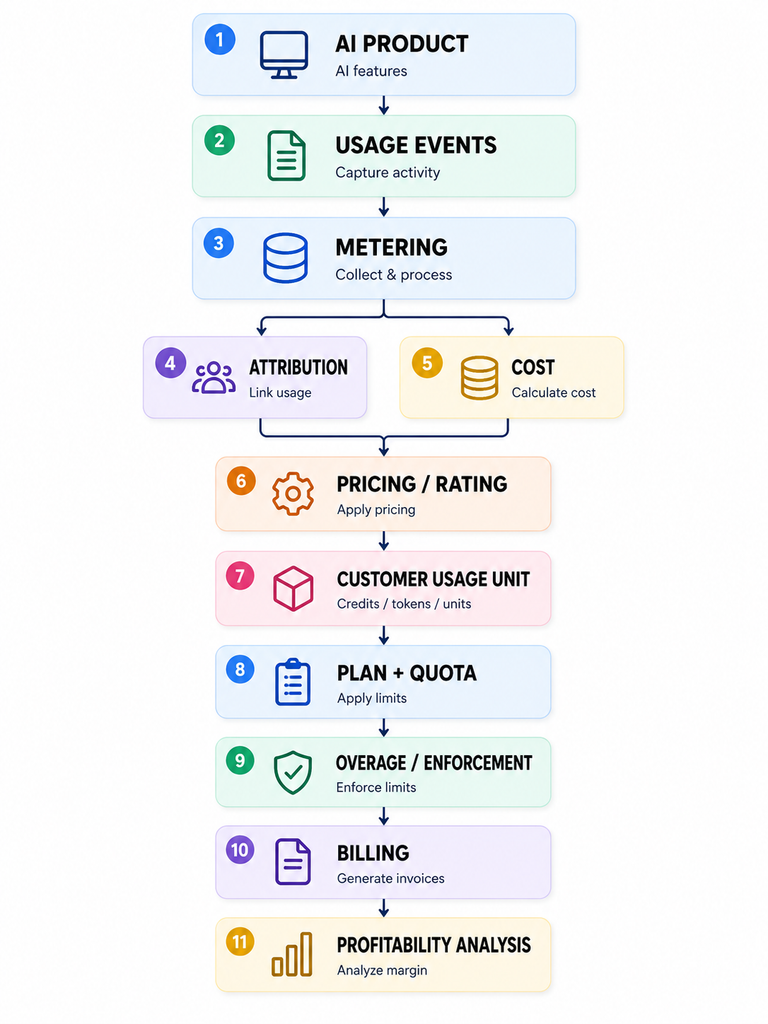
For most AI services, the architecture looks something like this:

AI activity
↓
Usage event
↓
Metering
↓
Attribution
↓
Cost calculation
↓
Pricing / rating
↓
Credits or billable units
↓
Plan limits + overages
↓
Invoice
↓
Profitability analysis

Each layer answers a different question.

Metering asks: What happened?

Attribution asks: Who caused it?

Costing asks: What did it cost us?

Pricing asks: What should that usage count as commercially?

Billing asks: What should the customer actually pay?

Keeping those questions separate makes usage-based pricing much easier to change, audit, and scale.

What does usage-based billing mean for an AI service?

Usage-based billing means that some or all of what a customer pays depends on measurable product consumption.

That consumption might be:

  • Input and output tokens
  • API calls
  • AI credits
  • Documents processed
  • Agent runs
  • Images generated
  • Audio minutes
  • Workflow executions
  • GPU or compute usage

The important point is that the unit you meter does not have to be the same unit the customer sees.

For example, internally your system may record:

Input tokens: 4,200

Output tokens: 650

Model: Model X

Feature: document_summary

Estimated cost: $0.036

while the customer sees:

Document summary: 50 credits

That separation gives an AI company much more flexibility.

The technical system records what actually happened. The commercial system decides how that usage should affect the customer.

1. Start with a trustworthy usage event

The foundation of usage-based billing is the usage event.

A usage event is a structured record of an action that occurred inside the product.

For an AI product, a simplified event might contain:

{
  "event_type": "completion",
  "customer_id": "cus_123",
  "user_id": "usr_456",
  "provider": "provider_a",
  "model": "model_x",
  "feature": "document_summary",
  "input_tokens": 4200,
  "output_tokens": 650,
  "total_tokens": 4850,
  "estimated_cost_usd": 0.036,
  "timestamp": "2026-09-03T10:30:00Z"
}

The exact schema will vary by product.
What matters is that the event gives you enough information to understand:

What happened? Who used it? What resources did it consume?

This is the foundation of AI usage metering.

If customer identity, model, feature, or usage metrics are missing at this stage, reconstructing them later can become difficult.

2. Separate measurable usage from descriptive context

A useful event model distinguishes between metrics and dimensions.

Metrics describe quantities:

input_tokens
output_tokens
total_tokens
requests
latency_ms
cost_usd
gpu_hours
audio_minutes
images_generated

Dimensions describe the context around those quantities:

customer_id
user_id
workspace_id
provider
model
feature
request_id
environment

This distinction makes the metering system adaptable.

If your product later starts measuring GPU time, transcription minutes, or a new AI workflow, you should be able to add those without redesigning the entire billing architecture.

That flexibility matters because AI products rarely stay tied to one model, provider, or usage type forever.

3. Keep metering separate from the product action

A common early-stage implementation is to put billing logic directly inside the code that makes the AI request.

It may work initially:

Call model
↓
Calculate tokens
↓
Deduct balance
↓
Return response

But this becomes difficult to maintain as pricing gets more complicated.

A cleaner model is:

Customer uses feature
↓
Application emits usage event
↓
Metering layer records it
↓
Commercial rules process it

This gives the billing system a consistent stream of usage data rather than forcing every product feature to understand pricing logic.

It also makes it easier to support real-time ingestion, delayed processing, batch imports, backfills, and historical corrections.

Instrumentation should describe usage. Pricing should interpret it.

4. Attribute usage to the right customer

A model provider may tell you that your company consumed $10,000 worth of AI this month.

That is useful.

But it does not answer:

Which customers generated that $10,000?

Customer-level attribution changes the usefulness of the data dramatically.

Instead of:

Total AI cost: $10,000

you may be able to see:

Customer A: $1,800

Customer B: $620

Customer C: $85

Then you can go deeper:

Customer A

Document analysis: $1,050

AI assistant: $500

Agent workflows: $250

This makes the same usage data useful for billing, pricing, product decisions, and margin analysis.

Tracking cost per customer is particularly important for AI products because two customers paying the same subscription fee can create very different costs.

5. Understand the underlying cost

Before deciding what customers should pay, understand what their usage costs you.

For token-priced LLMs, that may involve separate input and output rates.

A simplified calculation might be:

Input token cost
+
Output token cost
=
Estimated model cost

But many AI products now combine several resources.

A workflow may use:

  • An LLM
  • Embeddings
  • Retrieval
  • An external API
  • File processing
  • Another model call
  • Storage or compute

That means token usage alone may not represent the full cost of the product action.

LLM cost tracking helps connect model consumption to financial cost, while broader product metering can account for other resources as well.

The goal is not necessarily perfect accounting at the request level.

The goal is to have cost information accurate enough to support pricing, margin, and product decisions.

6. Add a pricing or rating layer

Metering and pricing are not the same thing.

Suppose the system records:

4,850 tokens consumed

That is usage.

Suppose the estimated provider cost is:

$0.036

That is cost.

The next question is:

How should this event count toward the customer’s commercial usage?

It might become:

50 credits

or:

1 document

or:

$0.10 billable usage

or simply:

Included in plan

That translation is the rating or pricing layer.

This layer is valuable because it lets the business change pricing without changing how every AI feature is instrumented.

Your application can continue measuring the same underlying usage while commercial rules evolve.

7. Decide what customers should actually see

For developer infrastructure, exposing tokens may make sense.

For many AI SaaS products, tokens are too technical.

A business customer usually thinks in terms of:

  • Reports generated
  • Documents processed
  • Automations completed
  • AI actions
  • Credits remaining

rather than:

4,850 tokens

That is why many AI products use credits.

A possible flow is:

Raw usage
4,850 tokens
↓
Underlying cost
$0.036
↓
Pricing logic
↓
Customer consumption
50 credits

Engineering gets precise metering.

Finance sees cost.

The customer gets a simpler usage unit.

The tradeoffs between the two approaches are covered in AI Credits vs Tokens: Which Pricing Unit Should Your AI Product Use?

8. Treat credits as transactions, not only a balance

If your product uses credits, a single number such as:

Balance: 14,250 credits

is useful for the UI.

But behind that balance, it is valuable to preserve the events that changed it.

For example:

+20,000   Monthly allocation

-50       Document summary

-200      Research workflow

+500      Promotional adjustment

This makes the balance explainable.

Credits may be added or removed because of subscriptions, purchases, usage, refunds, promotions, adjustments, or corrections.

A transaction history makes it easier to answer one of the most important billing questions:

Why does the customer have this balance?

This becomes increasingly important as pricing becomes more sophisticated.

9. Connect usage to plans and entitlements

A pricing plan does more than define a monthly price.

It also defines what the customer is entitled to consume.

For example:

Pro PlanStarter Plan
$199/month
25,000 credits included
Monthly reset
Overage enabled
$49/month
5,000 credits included
Hard limit
No overage

Metering tells you how much the customer has consumed.

The plan tells you how much they are allowed to consume under their subscription.

The enforcement layer decides what happens next.

10. Define what happens at the limit

A usage quota is only useful if the product knows what happens when the customer reaches it.

There are three common approaches.

Hard limitUsage stops when the allowance is exhausted
Soft limitUsage continues but warnings or upgrade prompts appear
OverageUsage continues and excess consumption becomes billable

Different customer segments may need different policies.

For a self-serve product, a hard stop may be acceptable.

For an enterprise AI workflow, interrupting usage may be unacceptable, so overage billing or a negotiated limit may work better.

The important architectural point is that quota enforcement should be a business decision, not something hard-coded into raw usage collection.

11. Warn customers before they run out

Usage-based pricing works better when customers can see what is happening.

Useful signals might include:

50% of allowance used
80% used
90% used
Low credit balance
Overage started

This improves customer experience and can also create expansion signals.

A customer consistently approaching their limit may be ready for:

  • A higher plan
  • More included credits
  • A usage commitment
  • Enterprise pricing

Usage visibility is therefore both a billing function and a product-growth function.

12. Separate raw usage from billable usage

This is one of the most important distinctions in the architecture.

Not every usage event that creates cost should be charged to the customer.

Examples include:

  • Internal usage
  • Free trial activity
  • Failed requests
  • Retries
  • Promotional usage
  • Customer support adjustments
  • Usage already included in the subscription

That means your system needs to distinguish:

Raw usage
↓
Metered usage
↓
Rated usage
↓
Billable usage

Only the final commercial result should feed invoicing.

This is what allows the company to make pricing decisions without corrupting the underlying usage record.

13. Design for events that cannot be priced

Real-world billing systems encounter events they do not immediately know how to handle.

A new model may appear.

A provider configuration may be missing.

A previously unseen event type may arrive.

A pricing rule may not match.

A dangerous system silently ignores these events.

Another dangerous system guesses.

A better architecture gives unresolved usage an explicit exception path so it can be reviewed and corrected without losing the original event.

You do not need to expose every internal detail of that process to customers.

But the architecture should assume that billing will sometimes encounter incomplete or unexpected data.

Reliable billing needs a failure path, not just a happy path.

14. Make billing explainable

Customers eventually ask questions such as:

Why was I charged this amount?

Why did my credits disappear?

When did my overage start?

Which usage caused this invoice?

If the answer cannot be reconstructed, trust in usage-based pricing deteriorates quickly.

That is why billing systems benefit from preserving the relationship between:

→usage event

→ pricing decision

→ customer consumption

→ invoice

You do not necessarily need to expose every raw technical event to the customer.

But internally, the path from usage to charge should be traceable.

15. Use the same data to understand profitability

Usage-based billing should eventually answer two different financial questions:

What should this customer pay?

and:

Is this customer profitable?

Suppose:

Customer revenue: $599

AI provider cost: $140

Other variable cost: $35

Gross profit: $424

Now compare that with another customer paying the same $599 but generating $500 in variable AI cost.

Revenue alone does not reveal the difference.

Customer-level metering makes it possible to connect revenue, provider cost, usage, and gross margin.

That is where billing data becomes business intelligence.

Our AI Cost Attribution guide explains how customer and feature-level cost attribution supports those decisions.

A practical AI usage-based billing architecture

This architecture is valuable because each layer has a clear responsibility.

You can change your pricing without rewriting instrumentation.

You can change your model provider without redesigning your customer plans.

You can offer different commercial terms to different customers while preserving the same underlying usage record.

And you can explain why a customer was billed without trying to reconstruct history from provider invoices.

Common mistake: treating the payment provider as the metering system

Payment platforms are excellent at collecting money.

But they do not automatically understand what happened inside your AI application.

Your product still needs to decide whether:

6,000 input tokens
+
1,200 output tokens
+
2 model calls

should become:

80 credits
or:
$0.50 in billable usage
or:
Included in subscription

The payment system can invoice the result.

It should not be responsible for discovering the meaning of the underlying AI usage.

This is why AI Usage Metering: Why AI Products Need Usage Tracking Before They Need Billing argues for building a reliable usage layer first.

How MetricaOS fits into this architecture

MetricaOS is designed as the metering and monetization layer between AI product usage and billing.

It helps teams capture structured usage, associate it with customers and product context, understand provider and model costs, apply commercial usage logic, manage credits and plan allowances, handle overages, and analyze the resulting customer economics.

The MetricaOS application itself reflects these layers through areas for usage events and schemas, providers, credit rules, customer wallets, plans, analytics, invoicing, exception handling, and auditability.

The goal is not simply to count tokens.

It is to create a reliable connection between:

AI activity → usage → cost → customer consumption → billing → revenue

without forcing product teams to rebuild that infrastructure every time their pricing model changes.

Build the usage layer before billing becomes complicated

Early AI products can often survive with a few counters and simple plan limits.

But complexity tends to arrive quickly.

New models appear.

Provider pricing changes.

Customers request custom terms.

Credits are introduced.

Enterprise accounts want overages instead of hard limits.

Finance wants margin visibility.

Customers want usage explanations.

Pricing evolves.

The earlier the product has a reliable usage foundation, the easier these changes become.

The implementation order is therefore straightforward:

Capture usage accurately. Preserve customer context. Understand cost. Apply commercial rules. Then bill.

That separation makes usage-based pricing easier to operate today and much easier to change tomorrow.

AI Credits vs Tokens: Which Pricing Unit Should Your AI Product Use?

Jeenfer Wilson · August 22, 2026 · Leave a Comment

AI products need a way to answer two very different questions:

How much AI did the customer actually use?

And:

How much of that usage should the customer pay for?

Tokens are often good at answering the first question.

Credits are often better at answering the second.

That distinction matters because AI products frequently make the mistake of treating their underlying infrastructure unit as their customer-facing pricing unit.

If your application consumes 4,800 tokens to complete a task, that does not necessarily mean your customer should see, understand, or pay for exactly 4,800 tokens.

For many AI products, the better architecture is:

Meter the underlying usage in tokens and other raw units. Convert that usage into credits according to your pricing rules.

That gives engineering teams accurate usage data while giving customers a pricing unit that is easier to understand and control.

So should your AI product price in tokens or credits?

The answer depends on what you are selling, who your customers are, and how closely your infrastructure usage maps to customer value.

What are tokens?

Tokens are units used by large language models to process text.

When an application sends text to an LLM, the text is broken into tokens. The model also generates output tokens when it responds.

A typical request might look like:

Input tokens: 4,200

Output tokens: 650

Total tokens: 4,850

Different models and providers may charge different prices for input tokens, output tokens, cached tokens, or other forms of usage.

This makes tokens extremely useful for measuring the underlying consumption of an AI system.

With token metering, an AI product can track usage by dimensions such as:

  • Customer
  • User
  • Model
  • Provider
  • Feature
  • Request
  • Workspace
  • Billing period

That data can then support cost tracking, profitability analysis, quotas, and billing.

But there is a problem.

Tokens are an infrastructure unit, not necessarily a customer-value unit.

What are AI credits?

AI credits are a customer-facing usage unit that represents a defined amount of AI consumption.

Instead of exposing raw token usage, an AI product might say:

Your plan includes 20,000 AI credits per month.

Different product actions can consume different numbers of credits.

For example:

Generate an email: 10 credits

Summarize a document: 50 credits

Analyze a report: 150 credits

Run an AI agent workflow: 500 credits

The customer sees credits.

Behind the scenes, the product may still measure tokens, requests, compute, model cost, or multiple other metrics.

This makes credit-based pricing an abstraction layer between technical consumption and customer pricing.

That abstraction can be extremely valuable for AI products.

Tokens measure infrastructure. Credits can represent product value.

This is the most important distinction.

Suppose your product has two features.

Feature A: Short AI response

Input tokens: 500

Output tokens: 200

Total tokens: 700

Feature B: Research workflow

Input tokens: 8,000

Output tokens: 3,000

Total tokens: 11,000

Charging directly by tokens would make Feature B roughly 16 times more expensive based purely on token consumption.

But perhaps Feature B creates far more customer value. It might replace 30 minutes of manual research while Feature A only rewrites a sentence.

Alternatively, Feature B might involve several model calls, data retrieval, external APIs, storage, and processing that token counts alone do not capture.

A credit system allows the company to price the product action, not just the raw LLM consumption.

For example:

Short AI response: 5 credits

Research workflow: 200 credits

The credit values can incorporate:

  • Token consumption
  • Provider cost
  • Model choice
  • Compute
  • External API cost
  • Product value
  • Desired margin
  • Pricing strategy

This is why tokens and credits should not automatically be treated as interchangeable.

Why tokens are excellent for internal metering

Even if customers never see tokens, AI companies often need to track them internally.

Token data helps answer questions such as:

  • Which customer is generating the most LLM usage?
  • Which model is responsible for most of our spend?
  • Are output tokens increasing?
  • Which features consume the most tokens?
  • What does a particular workflow actually cost us?

A structured AI usage metering system might record:

Customer ID: cus_123

Provider: provider_a

Model: model_x

Feature: document_summary

Input tokens: 4,200

Output tokens: 650

Total tokens: 4,850

Estimated cost: $0.036

This raw usage layer gives teams the precision needed to understand what is happening inside the product.

It also provides the foundation for LLM cost tracking and customer-level profitability analysis.

Without accurate raw usage data, a credit system can become little more than guesswork.

Why exposing tokens to customers can create problems

Token pricing can work well for technical audiences, particularly developers who already understand LLM APIs.

But for many SaaS customers, tokens are difficult to interpret.

Consider a pricing page that says:

Pro plan

5 million tokens per month

A potential customer may immediately wonder:

  • How many documents is that?
  • How many reports can I generate?
  • How many conversations does that give my team?
  • Will one large PDF use half of my allowance?

The number is technically precise but commercially unclear.

Compare that with:

Pro plan

20,000 AI credits per month

If the product also explains that:

Email generation: around 10 credits

Document summary: around 50 credits

Research report: around 200 credits

the customer can connect usage to product actions much more easily.

Credits allow the company to translate infrastructure complexity into something closer to the way customers experience the product.

The strongest architecture often uses both

The tokens-versus-credits decision does not need to be either/or.

For many AI products, the strongest approach is:

Raw usage

↓

Metered usage

↓

Cost calculation

↓

Credit conversion

↓

Customer wallet or allowance

↓

Billing

The product measures the technical reality first.

Then a pricing layer determines how that usage should translate into customer consumption.

For example:

Usage event

Input tokens: 4,200

Output tokens: 650

Provider: Provider A

Model: Model X

Customer: cus_123

The pricing engine might then evaluate a rule:

If:

Provider = Provider A

Model = Model X

Event type = completion

Then:

Calculate underlying model cost

Apply pricing/margin rule

Convert usage into credits

Deduct credits from customer balance

This separation is important.

Metering describes what happened. Pricing decides what that event is worth commercially.

Not every credit needs to equal a fixed number of tokens

One tempting approach is:

1 credit = 1,000 tokens

That is simple, but it can become restrictive.

Different models may have dramatically different costs. Input and output tokens may be priced differently. Image generation, transcription, embeddings, agents, and external tools may not fit naturally into a token-only system.

Instead, credits can be calculated differently depending on the event.

For example:

Cheap model request:

1,000 tokens = 1 credit

Premium model request:

1,000 tokens = 8 credits

Image generation:

1 image = 30 credits

Agent workflow:

1 execution = 100 credits

The customer still interacts with one consistent currency: credits.

Internally, the product can meter completely different underlying usage types.

This makes credits particularly useful for products that combine several AI providers, models, and modalities.

Credits also make provider changes easier

Imagine your product prices directly in tokens.

You initially use Model A.

Six months later, you move one workflow to Model B because it provides better quality or lower cost.

The customer may now consume a completely different number of tokens for the same product outcome.

If your pricing is tightly coupled to token usage, changes to your AI stack can unexpectedly change what customers pay.

Credits introduce a buffer between infrastructure and pricing.

Your customer can still pay:

Document analysis: 50 credits

while the implementation behind that feature changes.

This allows the engineering team to optimize providers and models without constantly redesigning the customer-facing pricing model.

Credits are not automatically better

Credits also create their own problems.

The biggest one is opacity.

If customers cannot understand how credits are consumed, the pricing system can feel arbitrary.

A customer who sees:

You used 3,800 credits today.

may reasonably ask:

On what?

A good credit system therefore needs visibility.

Customers should be able to understand:

  • Current credit balance
  • Credits consumed
  • Usage history
  • Which actions consumed credits
  • When credits reset
  • Whether unused credits roll over
  • What happens when the balance reaches zero
  • Whether overages are allowed

The credit abstraction should simplify pricing, not hide it.

Credits need a reliable wallet and ledger

Once credits become part of your pricing model, they should be treated as a real accounting unit inside the product.

A customer may receive credits through:

  • Subscription allowances
  • Purchases
  • Promotions
  • Adjustments
  • Refunds

And credits may be consumed through different product events.

A reliable system should maintain an immutable transaction history rather than simply updating a balance.

For example:

+20,000   Monthly subscription allocation

-50       Document summary

-200      Research workflow

-10       Email generation

+500      Promotional credit

The resulting balance can then be reproduced from the underlying transactions.

This is especially important when credits are connected to invoices, customer disputes, usage limits, or enterprise contracts.

Credits and subscription plans

Credits work particularly well with hybrid subscription models.

For example:

StarterProBusiness
$49/month$199/month$599/month
5,000 credits included25,000 credits included100,000 credits included

The company then needs to decide what happens when customers approach or exhaust their allowance.

Possible policies include:

  • Hard stop
  • Upgrade required
  • Purchase additional credits
  • Automatic overage
  • Soft limit with alerts
  • Temporary grace usage

This is where usage quotas become important.

A pricing model is not complete merely because the company defines the number of included credits. It also needs clear enforcement behavior.

Should unused credits roll over?

This is another product decision that token pricing alone does not solve.

Suppose a customer receives:

20,000 credits per month

and uses only 12,000.

Should the remaining 8,000 disappear?

Or should they carry forward?

Both approaches can work.

No rollover creates predictable monthly allowances and limits accumulated liability.

Rollover credits can make customers feel that they are receiving more value and may work especially well when usage is irregular.

The important point is that the policy should be intentional and visible.

What about overages?

Credits can also support usage-based billing.

For example:

Pro plan: $199/month

Included:

25,000 credits

Additional usage:

$10 per 5,000 credits

This creates a hybrid model:

Subscription + included usage + overage

The base subscription provides predictable recurring revenue.

Credits define the included consumption.

Overages allow revenue to increase with unusually heavy usage.

For AI products with variable infrastructure costs, this can be substantially safer than unlimited usage.

Tokens can still be the better customer-facing unit

There are cases where customers should see tokens.

This is especially true for developer infrastructure products.

If your users are developers building directly on top of APIs or models, they may already think in terms of:

  • Input tokens
  • Output tokens
  • Cached tokens
  • Requests
  • Model rates

In that situation, hiding everything behind credits may actually make the pricing less transparent.

A developer platform may be better served by something like:

Input tokens: $X per million

Output tokens: $Y per million

The rule of thumb is simple:

If your customers think about the infrastructure, tokens may make sense.

If your customers think about product outcomes, credits are often easier.

How to decide between credits and tokens

Consider four questions.

1. Who is your customer?

Technical infrastructure buyer?

Tokens may be perfectly understandable.

Business user?

Credits or product-specific units may be clearer.

2. Does token usage closely represent customer value?

If more tokens consistently mean more customer value, token pricing may work.

If token consumption varies dramatically for similar outcomes, credits provide more control.

3. Does your product use multiple models or usage types?

If your product combines LLM tokens, image generation, transcription, workflows, APIs, and compute, one credit currency can simplify the experience.

4. Do you want pricing independent from your AI infrastructure?

If you expect to change providers, models, routing, or workflows frequently, credits create useful separation between your technical architecture and commercial model.

The margin question matters more than the unit

Ultimately, neither credits nor tokens solve pricing by themselves.

A company can sell credits and still lose money.

A company can price directly in tokens and still build a profitable product.

The important question is:

Does the amount customers pay increase appropriately as the cost and value of their usage increase?

That requires understanding cost per customer and accurately attributing costs to the customers and features responsible for creating them.

Our guide to AI Cost Attribution explains how to connect model spend to those product dimensions.

Once you understand customer-level usage and cost, you can decide how aggressively credits should be consumed, how large plan allowances should be, and when overages become necessary.

How MetricaOS connects tokens, credits, and billing

MetricaOS separates usage measurement from monetization.

AI teams can ingest structured usage events containing metrics such as input tokens, output tokens, cached tokens, total tokens, latency, cost, provider, model, customer, user, and other product context.

Teams can then define credit rules that determine which usage metrics should consume credits and under what conditions.

Provider pricing and margin rules can be used alongside those events, while customer wallets track balances and credit transactions.

Subscription plans can define:

  • Credits included per billing period
  • Billing cycle
  • Hard credit limits
  • Credit rollover
  • Overage behavior

This allows an AI company to keep the technical layer accurate while building a customer-facing pricing model around credits.

The result is a clearer separation:

Tokens tell you what was consumed.

Costs tell you what that consumption cost you.

Credits tell the customer how much priced usage they consumed.

Billing determines what they ultimately owe.

That separation is one of the foundations of sustainable AI monetization.

Credits vs tokens: the practical answer

If you are building an AI infrastructure product for developers, exposing tokens may be the simplest and most transparent option.

If you are building an AI SaaS product around customer workflows and outcomes, credits are often easier for customers to understand and give the business more flexibility.

But in many cases, the best answer is:

Use tokens internally. Use credits externally.

Measure the real underlying consumption with precision.

Then translate that consumption into a pricing unit designed around your customers, your product, and your margins.

Because your billing unit does not have to be the same as your infrastructure unit.

AI Cost Attribution: How to Know Which Customers and Features Drive Your LLM Spend

Jeenfer Wilson · July 19, 2026 · Leave a Comment

AI companies often know how much they spend on model providers every month.

They may see a bill for $2,000, $20,000, or $200,000. But that number alone does not explain where the cost came from.

It does not tell the team:

  • Which customers generated the most cost
  • Which features are expensive to operate
  • Which models are driving spend
  • Which workflows are profitable
  • Whether a pricing plan still protects margin

This is the problem AI cost attribution solves.

AI cost attribution connects model and infrastructure costs to the product activity responsible for creating them. It turns a provider invoice into actionable customer, feature, model, and workflow-level information.

Without it, AI teams can see total spend but cannot reliably explain it.

What is AI cost attribution?

AI cost attribution is the process of assigning AI-related costs to the customers, users, workspaces, features, models, or workflows that generated them.

For example, a provider bill may show:

Total monthly LLM spend: $18,500

AI cost attribution adds product context:

Customer A: $3,200
Customer B: $1,450
Customer C: $120
Document analysis feature: $8,700
AI assistant feature: $5,300
Report generation feature: $4,500

The total spend has not changed. But the company can now understand who and what created it.

Cost attribution depends on reliable AI usage metering. The product must first record usage with enough context to connect every relevant event to a customer, feature, model, and cost.

Why provider invoices are not enough

Model-provider invoices are useful for accounting, but they are usually too broad for product and pricing decisions.

They may show total usage by model, project, API key, or account. But they do not automatically understand the internal structure of your product.

The provider usually does not know:

  • Which of your customers initiated a request
  • Which product feature generated it
  • Whether the request was part of a free trial
  • Whether it should consume customer credits
  • Whether it was a retry or duplicate
  • Whether the request was internal or customer-facing
  • Which subscription plan the customer uses

That context exists inside your application.

A provider can tell you what was consumed. Your product must explain why it was consumed and who was responsible.

This is why LLM cost tracking needs to happen at the product level rather than only at the provider-account level.

What should AI costs be attributed to?

The right attribution dimensions depend on how your product is structured. Most AI products should start with a few core dimensions.

Customer

Customer-level attribution answers:

How much did this customer cost us to serve?

This is one of the most commercially useful views because it connects usage directly to revenue and margin.

If a customer pays $199 per month but creates $280 in model cost, the problem is not visible from subscription revenue alone.

Tracking cost per customer helps teams identify expensive accounts, evaluate plan profitability, and decide when pricing or usage controls need to change.

User or workspace

In B2B products, one customer account may contain many users, teams, projects, or workspaces.

Workspace-level attribution can reveal that one department creates most of the account’s usage while others use very little.

This information can support:

  • Workspace quotas
  • Departmental chargebacks
  • Admin usage reports
  • Seat-and-usage pricing
  • Enterprise contract discussions

Feature

Feature-level attribution answers:

Which AI features create the most cost?

A product may offer document summarization, content generation, search, transcription, data extraction, and agent workflows. These features can have very different cost profiles.

For example:

Document summarization: $4,800
Agent workflows: $9,600
AI search: $1,300
Email generation: $700

A feature with high adoption may still be unattractive if it creates disproportionate cost without supporting retention, upgrades, or revenue.

Feature-level attribution helps product teams decide where to optimize, restrict, redesign, or charge more.

Model and provider

Different models may have different cost, speed, quality, and context requirements.

Model-level attribution helps teams understand:

  • Which models drive the most spend
  • Whether premium models are used unnecessarily
  • Whether cheaper models can handle certain tasks
  • Whether routing logic is working
  • How provider changes affect margins

Two features may process similar usage volumes but create very different costs because they use different models.

Workflow or operation

Some AI actions require only one model request. Others may trigger multiple steps.

An agent workflow might:

  1. Retrieve stored information
  2. Call a language model
  3. Use an external tool
  4. Call the model again
  5. Generate a final response

Looking at only the final model call would understate the true cost of the workflow.

Workflow-level attribution combines all related costs into a single product action that the business can understand.

What data does AI cost attribution require?

Cost attribution starts with a well-structured usage event.

A basic event might look like this:

{

  "event_type": "llm_request_completed",

  "customer_id": "cus_123",

  "user_id": "user_456",

  "workspace_id": "workspace_789",

  "feature": "document_analysis",

  "workflow_id": "workflow_987",

  "provider": "model_provider",

  "model": "premium-language-model",

  "input_tokens": 4200,

  "output_tokens": 650,

  "estimated_cost_usd": 0.036,

  "billable": true,

  "timestamp": "2026-07-19T10:30:00Z"

}

The token values explain how much language-model usage occurred.

The customer, workspace, feature, and workflow fields explain where that usage belongs.

The estimated cost explains the financial impact.

Without those attribution fields, the company may know that 4,850 tokens were consumed but not which customer or feature consumed them.

For a deeper explanation of the usage layer, see Token Metering for AI Products.

How AI cost is calculated

For token-priced models, a simplified request-cost calculation may look like this:

Input cost = input tokens × input token rate

Output cost = output tokens × output token rate

Request cost = input cost + output cost

The product can then aggregate request costs by customer, feature, model, or billing period.

Customer cost = sum of all attributed customer events

Feature cost = sum of all attributed feature events

Workflow cost = sum of all events within the workflow

But not every AI cost is token-based.

Depending on the product, cost attribution may also include:

  • Embedding generation
  • Image generation
  • Audio transcription
  • Text-to-speech
  • Reranking
  • External tools
  • Vector database usage
  • File processing
  • Compute
  • Storage
  • Third-party APIs

A reliable system should support the usage units that matter to the product rather than assuming every AI event is identical.

Estimated cost vs finalized cost

Real-time cost attribution often uses estimated cost.

When a request finishes, the product records the usage and applies the relevant provider rate. This allows dashboards, alerts, credits, and limits to update immediately.

However, final provider charges may occasionally differ because of discounts, committed-use agreements, caching, batch pricing, regional pricing, or pricing changes.

It is therefore useful to distinguish between:

  • Estimated cost: calculated when the usage event occurs
  • Finalized cost: reconciled against confirmed provider billing data

For many product decisions, a reliable estimate is enough. But financial reconciliation may require a separate finalization process.

Teams should also store the pricing version or rate used for each calculation. Otherwise, a future pricing change could incorrectly alter historical cost.

Raw usage, attributed cost, and billable usage

These concepts are related, but they should not be treated as the same thing.

Raw usage

Raw usage describes what technically happened.

4,200 input tokens

650 output tokens

One model request

Attributed cost

Attributed cost connects that usage to the responsible product dimensions.

Customer: cus_123

Feature: document_analysis

Estimated cost: $0.036

Billable usage

Billable usage determines what should count toward the customer’s plan, credits, overage, or invoice.

A request may create real cost without being billable. Examples include:

  • Free trial usage
  • Internal testing
  • Failed requests
  • Customer support credits
  • Promotional usage
  • Product-generated background tasks

This distinction matters because cost and billing are not identical.

A company must understand the cost of all relevant usage, even when it chooses not to charge the customer for that usage.

Accurate attribution creates the foundation for usage-based billing, but billing rules should remain a separate business layer.

How AI cost attribution protects margins

AI cost attribution makes gross-margin problems visible before they become severe.

Imagine a product with a $99 monthly plan and 1,000 customers.

The company may initially see:

Monthly recurring revenue: $99,000

Monthly model spend: $24,000

At an aggregate level, the economics may appear acceptable.

But customer-level attribution could reveal:

700 customers cost less than $10 each

220 customers cost between $10 and $50 each

70 customers cost between $50 and $100 each

10 customers cost more than $500 each

A small number of customers may be responsible for a large share of total spend.

Without attribution, those customers remain hidden inside an average.

With attribution, the team can consider:

  • Moving heavy users to higher plans
  • Introducing overage charges
  • Reducing included usage
  • Applying usage quotas
  • Offering prepaid credit packages
  • Optimizing expensive workflows
  • Routing requests to more suitable models
  • Creating enterprise contracts for high-volume accounts

The goal is not simply to reduce usage. The goal is to ensure usage and revenue grow sustainably together.

How cost attribution improves pricing

AI pricing is difficult when teams do not know what their product costs at the customer and feature level.

Cost attribution provides evidence for pricing decisions.

For example, it can help a company determine:

  • How much usage each plan can include
  • Whether credits accurately reflect cost
  • Which features should be premium
  • Whether overage rates protect margin
  • Which customers need custom pricing
  • Whether an unlimited plan is sustainable

For products using credit-based pricing, attribution helps ensure credit consumption reflects the underlying economics.

A simple action may consume five credits, while an expensive workflow consumes 500. The difference should be based on real usage and cost rather than guesswork.

The broader pricing process is covered in Usage-Based Billing for AI Products.

How product teams use cost attribution

AI cost attribution is not only a finance function.

Product teams

Product teams can compare feature adoption with feature cost. A widely used feature may justify its cost, while an expensive low-value feature may need redesign.

Engineering teams

Engineering teams can find inefficient prompts, oversized context windows, unnecessary retries, expensive model choices, and workflows that trigger too many calls.

Finance teams

Finance teams can forecast model spend, monitor margins, reconcile provider charges, and understand cost growth.

Sales teams

Sales teams can identify accounts that need enterprise pricing or custom usage commitments.

Customer-success teams

Customer-success teams can warn customers about unusual usage, explain quota consumption, and recommend a more suitable plan.

A shared attribution layer gives these teams a consistent view of usage and cost.

Example: attributing cost across customers and features

Imagine an AI research platform with three main features:

Document summary

Question answering

Automated research report

At the end of the month, total AI spend is $12,000.

Feature-level attribution shows:

Document summary: $2,100

Question answering: $3,400

Automated research report: $6,500

Customer-level attribution shows:

Customer A: $2,800

Customer B: $1,900

Customer C: $220

All other customers: $7,080

The team then discovers that Customer A runs automated research reports at a very high volume.

Customer A pays $499 per month but creates $2,800 in AI cost.

The company now has several options:

  • Add a report quota
  • Charge per additional report
  • Increase the report’s credit cost
  • Move the customer to an enterprise contract
  • Optimize the workflow
  • Use a cheaper model for intermediate steps

Before attribution, the problem was hidden inside a $12,000 provider bill.

After attribution, the company knows exactly where to act.

Common AI cost-attribution mistakes

Tracking only total provider spend

Total spend is useful for accounting but insufficient for customer, pricing, and product decisions.

Omitting customer and feature identifiers

Tokens without product context cannot be reliably assigned later. Important attribution fields should be recorded when the event occurs.

Using only average cost per customer

Averages can hide expensive outliers. Individual customer-level cost is often more useful.

Ignoring failed requests and retries

Retries can create additional cost. Teams need clear rules for recording, deduplicating, and billing them.

Mixing internal and customer usage

Development, testing, demos, and administrative usage should be labelled separately.

Assuming all tokens have the same cost

Input and output pricing may differ, and different models may have different rates. Cost calculations should use the correct model and pricing version.

Treating attributed cost as automatically billable

Some usage creates cost but should not be charged to the customer. Cost attribution and billing logic should remain distinct.

How to implement AI cost attribution

A practical implementation can be built in stages.

1. Define the attribution dimensions

Start with the dimensions required for business decisions:

Customer

User or workspace

Feature

Model

Provider

Workflow

2. Record structured usage events

Capture usage when it happens. Do not rely only on reconstructing it later from application logs.

3. Calculate request-level cost

Apply the correct pricing rules based on provider, model, usage type, and pricing version.

4. Aggregate cost

Create customer, feature, model, and workflow-level views.

5. Separate cost from billing

Record what the usage cost the company, then separately decide whether it consumes credits, counts toward a quota, or becomes billable.

6. Add alerts and controls

Notify teams when a customer, feature, or workflow crosses a meaningful cost threshold.

7. Review pricing and product decisions

Use the attribution data to adjust plans, limits, credit values, routing, and feature design.

How MetricaOS helps

MetricaOS helps AI product teams connect usage events to customers, users, workspaces, features, models, providers, and estimated costs.

Instead of stopping at a monthly provider bill, teams can understand:

  • Which customers generate AI cost
  • Which features consume the most resources
  • How model usage affects customer-level margins
  • How credits and quotas map to actual consumption
  • Which usage should become billable

MetricaOS provides the metering foundation needed to move from raw AI activity to cost visibility, pricing controls, and sustainable monetization.

For AI products, tracking total spend is only the beginning.

The more important question is:

Which customers, features, and workflows created that spend – and did the revenue justify it?

Token Metering for AI Products: How to Track LLM Usage by Customer, Feature, and Model

Jeenfer Wilson · July 9, 2026 · Leave a Comment

AI products have a hidden measurement problem.

A user clicks a button, asks a question, summarizes a document, generates a report, or runs an AI workflow. The product feels simple from the outside.

But behind that action, something measurable is happening.

The product may send a prompt to a language model. It may include conversation history, retrieved context, documents, system instructions, or customer data. The model may generate a response. That response may trigger another model call, a tool call, or a follow-up workflow.

Every one of those steps can consume tokens.

And those tokens create cost.

This is why token metering matters.

Token metering is the process of tracking how many input and output tokens are consumed by users, customers, features, models, and workflows inside an AI product.

For early prototypes, token usage may feel like a technical detail. But once real customers start using the product, token metering becomes a business requirement. It helps teams understand cost, enforce limits, design credits, monitor usage, and prepare for usage-based billing.

Without token metering, AI usage becomes difficult to explain.

You may know that your provider bill is increasing. But you may not know which customer caused it, which feature created it, or whether your pricing model can support it.

What is token metering?

Token metering is the process of measuring and recording token consumption in an AI product.

In large language models, text is processed as tokens. A token can be a word, part of a word, punctuation mark, or other text unit depending on the tokenizer used by the model.

When a user sends a request to an AI feature, the request usually consumes two types of tokens:

Input tokens

Output tokens

Input tokens are the tokens sent into the model. These can include the user prompt, system prompt, conversation history, retrieved context, document content, or tool instructions.

Output tokens are the tokens generated by the model in response.

For example, if a user asks an AI assistant to summarize a document, the usage may look like this:

Input tokens: 4,200

Output tokens: 650

Total tokens: 4,850

A token metering system records this usage and connects it to the right customer, user, feature, model, provider, and timestamp.

That data can then be used for dashboards, cost attribution, quotas, credits, billing, and margin analysis.

Token metering is one part of AI usage metering. AI usage metering can include many kinds of usage, such as API calls, credits, images generated, documents processed, minutes transcribed, or agent runs. Token metering focuses specifically on LLM token consumption.

Why token metering matters for AI products

Token metering matters because LLM usage has a direct cost.

In traditional SaaS, product usage does not always map directly to a unit cost. A customer can log in, create projects, invite team members, or use features without creating a large incremental cost every time.

AI products are different.

Every model request can create provider cost or infrastructure cost. That cost may vary depending on:

Model used

Input length

Output length

Context window size

Number of model calls

Provider pricing

Workflow complexity

Use of retries or fallback models

This means two customers on the same plan can have completely different cost profiles.

One customer may use a few short AI replies per month. Another may upload long documents, generate large reports, and run multi-step workflows every day.

If both customers pay the same subscription fee, but one consumes far more tokens, the business may lose margin without realizing it.

Token metering helps AI teams answer questions like:

  • Which customers consume the most tokens?
  • Which features generate the highest token usage?
  • Which models are most expensive in practice?
  • Are free trial users creating too much cost?
  • Which plan limits are being reached?
  • Should usage be priced with tokens, credits, or quotas?

Without token metering, these questions become guesswork.

Token metering by customer

The most important rule in token metering is simple:

Token usage should be tied to the customer who caused it.

It is not enough to know that your product used 50 million tokens this month. You need to know which customers, workspaces, teams, or tenants created that usage.

For a B2B AI product, customer-level token tracking is essential because billing and profitability usually happen at the account level.

For example:

Customer ACustomer B
Monthly revenue: $99
Token cost: $8
Monthly revenue: $99
Token cost: $120

Both customers may look the same in a subscription billing system. But from a margin perspective, they are very different.

Customer B may be a great customer if pricing and packaging are designed properly. But if the product offers unlimited usage or poorly designed credits, that customer may become unprofitable.

This is why token usage should be connected to:

Customer ID
Workspace ID
Tenant ID
Subscription plan
Billing status
Usage quota
Credit balance

For AI SaaS teams, customer-level token metering is the bridge between technical usage and business decisions.

Token metering by user and workspace

In many AI products, a single customer account has multiple users.

For example, a company may have 50 employees using the same AI support tool, research assistant, document automation platform, or sales AI product.

If token usage is only tracked at the customer level, the product team may know which account is consuming tokens, but not which users or teams are driving that usage.

User-level and workspace-level token metering can help answer questions like:

  • Which users are consuming the most AI?
  • Which team inside the customer account is driving cost?
  • Is one user accidentally triggering expensive workflows?
  • Should admins see usage by team or department?
  • Should usage limits apply per user, workspace, or customer?

This is especially useful when customers ask for usage reports.

A customer may not just want to know:

Your company used 500,000 tokens this month.

They may want to know:

Sales team: 220,000 tokens
Support team: 180,000 tokens
Operations team: 100,000 tokens

This level of visibility makes usage dashboards more useful and helps customers understand how AI is being consumed inside their organization.

Token metering by feature

Token metering should also track which product feature created the usage.

This is one of the most useful views for product and engineering teams.

For example, an AI product may have several features:

  • AI chat assistant
  • Document summarization
  • AI report generation
  • Customer support reply drafting
  • Data extraction
  • Agent workflow automation

Each feature may have a different token profile.

A chat assistant may create many small requests. A document summarization feature may create fewer but much larger requests. A report generation feature may have high output token usage. An agent workflow may trigger multiple model calls behind one user action.

If token usage is tracked by feature, the team can see which parts of the product are expensive to operate.

Example:

Document summarization: 42% of token usage
AI chat assistant: 25% of token usage
Report generation: 21% of token usage
Agent workflows: 12% of token usage

This helps teams decide:

  • Which features need usage limits?
  • Which features should consume more credits?
  • Which workflows should use cheaper models?
  • Which features are valuable but expensive?
  • Which features are hurting margin?

Feature-level token metering is also useful for pricing.

If one feature costs much more to operate than another, both should not necessarily consume the same number of credits.

This is where credit-based pricing becomes important. Credits can simplify pricing for customers, while token metering helps the company understand the real cost behind those credits.

Token metering by model and provider

Many AI products use more than one model or provider.

A product may use one model for chat, another for summarization, another for classification, and another for fallback. It may also use different providers depending on customer requirements, cost, latency, or performance.

For example:

OpenAI for high-quality generation
Anthropic for long-context reasoning
Azure OpenAI for enterprise customers
Open-source models for lower-cost workflows
Embedding models for retrieval

Token metering should track the model and provider used for each request.

This helps answer questions like:

  • Which provider is driving most of our cost?
  • Which model is used most often?
  • Which model has the highest cost per customer?
  • Are expensive models being used for low-value tasks?
  • Can some workflows move to cheaper models?

Without model-level token tracking, teams may only see total provider spend. That is not enough.

A good token metering system should capture fields like:

provider
model
input_tokens
output_tokens
estimated_cost
request_type
feature
customer_id

This creates a clear picture of how model usage maps to customer behavior and product cost.

Input tokens vs output tokens

Token metering should separate input tokens and output tokens.

Total tokens are useful, but they are not enough.

Input and output tokens often have different cost structures. Many model providers price them differently, and some workflows are more input-heavy while others are more output-heavy.

For example:

Document analysis:

High input tokens

Lower output tokens

Report generation:

Moderate input tokens

High output tokens

Chat assistant:

Input and output both vary with conversation history

If a product only tracks total tokens, it may miss important cost patterns.

A feature that sends very large documents to a model has a different cost profile from a feature that generates long reports. Both may have high total token usage, but the reason for that usage is different.

Separating input and output tokens helps teams optimize prompts, context size, response length, and model selection.

It also helps with pricing design.

If output tokens are more expensive, long-form generation features may need different limits or credit costs than short-response features.

What should a token usage event include?

A token usage event is a structured record of token consumption.

A simple event may look like this:

{

  "event_type": "llm_request_completed",

  "customer_id": "cus_123",

  "user_id": "user_456",

  "workspace_id": "workspace_789",

  "feature": "document_summary",

  "provider": "openai",

  "model": "gpt-4.1",

  "input_tokens": 4200,

  "output_tokens": 650,

  "total_tokens": 4850,

  "estimated_cost_usd": 0.036,

  "billable": true,

  "timestamp": "2026-07-09T10:30:00Z"

}

The exact fields depend on the product, but a good token metering event should usually include:

  • Customer identifier
  • User identifier
  • Workspace or tenant identifier
  • Feature or workflow name
  • Provider
  • Model
  • Input tokens
  • Output tokens
  • Total tokens
  • Estimated cost
  • Billable status
  • Timestamp
  • Environment
  • Request ID or idempotency key

The request ID or idempotency key is especially important for avoiding duplicate counting when requests are retried.

Raw token usage vs billable token usage

Not all token usage should be billable.

This is an important distinction.

A product may generate token usage from:

Customer actions
Internal testing
Demos
Admin workflows
Failed requests
Retried requests
Free trial users
Promotional credits
Background jobs
System evaluations

Some of this usage should count toward customer billing. Some should not.

This is why AI teams should separate:

Raw usage

Metered usage

Billable usage

Invoiced usage

Raw usage is every model call or token-consuming event.

Metered usage is usage that has been captured and attributed to the correct customer, user, feature, or workflow.

Billable usage is the portion of usage that should count toward credits, quotas, or invoices.

Invoiced usage is the final usage that appears in a billing system after adjustments, discounts, exclusions, or credits.

This distinction matters because billing directly from raw logs can create mistakes.

For example, if a failed request is retried three times, should the customer be charged for all attempts or only the successful final result?

The answer depends on the product and billing policy. But the metering system needs enough data to make that decision.

This is why usage-based billing should be built on a reliable metering layer, not just raw provider data.

Token metering and credit-based pricing

Many AI products do not show token usage directly to customers.

Instead, they use credits.

This is often a good decision.

Most business users do not want to think about input tokens, output tokens, provider pricing, or model-specific cost. They want a simpler usage unit.

For example:

You have 10,000 AI credits this month.

Different actions may consume different numbers of credits:

Short AI reply: 5 credits
Document summary: 50 credits
Long report generation: 200 credits
AI workflow run: 500 credits

Behind the scenes, token metering helps calculate how those credits should work.

A product team may decide credit costs based on:

Average token usage
Model cost
Feature complexity
Customer value
Desired gross margin
Plan type

This is why credits and tokens are not opposites.

Tokens are often the internal measurement unit. Credits are often the customer-facing packaging unit.

Good credit-based pricing usually depends on reliable token metering underneath.

Token metering and quotas

Token metering also supports quotas and limits.

A quota defines how much usage is included in a plan.

For example:

Starter plan: 100,000 tokens/month

Pro plan: 1 million tokens/month

Business plan: 10 million tokens/month

Or, if the product uses credits:

Starter plan: 2,000 credits/month

Pro plan: 20,000 credits/month

Business plan: 100,000 credits/month

Token metering helps the system know how much usage has been consumed and how much remains.

Quotas can be enforced in different ways:

Hard limits
Soft limits
Usage alerts
Overage billing
Throttling
Upgrade prompts

For early AI products, even basic quota visibility can be valuable.

It helps teams avoid unexpected provider bills, protect free trials, and design better pricing plans.

Common token metering mistakes

Many teams start token metering too late.

At first, it feels easier to rely on provider dashboards. But provider dashboards usually show total usage and spend. They do not always connect usage cleanly to your customers, features, plans, or internal workflows.

Another common mistake is tracking tokens without customer attribution.

Knowing that your product used 10 million tokens is useful. Knowing that one customer used 6 million of those tokens is much more useful.

Teams also sometimes ignore output tokens. This can create inaccurate cost analysis, especially for products that generate long reports, documents, summaries, or chat responses.

Another mistake is mixing internal usage with customer usage. Development, testing, demos, and admin actions can create real token cost. If these are not separated, customer profitability analysis becomes unreliable.

A more serious mistake is double-counting retries. If a request fails and is retried, the metering system should be clear about what gets counted and what becomes billable.

Finally, some teams jump into billing before they trust their token data. That can create customer disputes later.

If customers are charged based on usage, the underlying usage data must be accurate and explainable.

When should AI teams add token metering?

AI teams should add token metering before usage becomes difficult to reconstruct.

You do not need a perfect metering system on day one. But you should start capturing the basics early.

At minimum, track:

Customer ID
User ID
Feature
Provider
Model
Input tokens
Output tokens
Estimated cost
Timestamp
Billable status

This gives you enough history to understand usage patterns later.

Waiting too long creates problems.

If you launch pricing, credits, quotas, or overages without historical token data, you may design plans based on guesses. You may not know how much usage normal customers consume, how expensive heavy users are, or which features create the most cost.

Early token metering gives you the data needed to price with more confidence.

Token metering is not just a developer task

It is easy to think token metering belongs only to engineering.

But token metering affects several teams.

For founders, it helps answer whether the business model is sustainable.

For product teams, it shows which features drive cost and usage.

For engineering teams, it helps optimize prompts, models, and workflows.

For finance teams, it connects provider costs to customer revenue.

For customer success teams, it supports usage conversations with customers.

Token metering is technical infrastructure, but the value is business visibility.

That is why it should not be treated as an afterthought.

How MetricaOS helps

MetricaOS helps AI product teams track usage across customers, users, features, models, and providers.

For token metering, MetricaOS gives teams a clearer view of how LLM usage maps to customer behavior, product features, and cost.

Instead of relying only on provider dashboards, teams can use MetricaOS to understand:

  • Which customers consume the most tokens
  • Which features create the most AI cost
  • Which models are driving usage
  • How usage connects to credits, quotas, and billing
  • Whether customers are profitable at current pricing

For AI products, token metering is not just about counting tokens. It is about understanding consumption before pricing, billing, and margins become messy.

  • Page 1
  • Page 2
  • Go to Next Page »

MetricaOS

Copyright © 2026 · Monochrome Pro on Genesis Framework · WordPress · Log in